Your PyTorch script runs on a Cloud TPU without throwing a single exception—while quietly losing 2,537× in step throughput.
Porting CUDA-oriented PyTorch and Hugging Face scripts to Google Cloud TPUs used to fail loudly behind PyTorch/XLA boilerplate. With the new open-source TorchTPU (torch_tpu) backend, standard PyTorch code runs directly on device="tpu"—which creates a subtler engineering problem: silent performance cliffs. Unpatched device helpers fall back to 'cpu', hidden scalar readbacks stall HBM-to-host transfers inside library internals, and ragged batch shapes trigger 45–77 second XLA recompilations on every step.
TorchTPU Doctor (torchtpu-doctor) is an open-source Agent Skill, zero-dependency AST linter, TorchDispatchMode warmup profiler, and runtime patch kit built to diagnose and eliminate those bottlenecks automatically—cutting compiled Qwen2.5-0.5B-Instruct LoRA fine-tuning step time on a Cloud TPU v6e-1 (Trillium) VM from 47.3 seconds/step down to 18.6 ms/step (2,537× faster) and producing three upstream ecosystem contributions across Hugging Face and Google PyTorch (huggingface/transformers#50267, huggingface/peft#4099, and google-pytorch/torch_tpu#6127).
1. From PyTorch/XLA Ceremony to Native torch_tpu
At PyTorch Conference 2026, Google and Meta’s PyTorch team open-sourced TorchTPU (torch_tpu)—a native, principled PyTorch backend for Google Cloud TPUs (Google Cloud announcement · PyTorch technical blog · Cloud TPU docs).
Anyone who trained models on PyTorch/XLA a couple of years ago remembers the Lazy Tensor ceremony: xm.xla_device(), manual xm.mark_step() barriers at the end of every training step, and custom ParallelLoader wrappers. With torch_tpu, TPUs sit right alongside GPUs and CPUs behind first-class PyTorch APIs:
import torch

device = torch.accelerator.current_accelerator()  # torch.device('tpu')
model = MyModel().to(device, dtype=torch.bfloat16)
compiled = torch.compile(model, backend="tpu", dynamic=False)
Naturally, the first thing I wanted to test was moving a standard Hugging Face transformers + peft LoRA supervised fine-tuning script (Qwen/Qwen2.5-0.5B-Instruct) onto a single Cloud TPU v6e-1 (Trillium) VM to see how far “runs out of the box” goes in practice.
- The good news: The script ran end-to-end without throwing a single exception, and training loss decreased cleanly.
- The catch:
peft’s device helper quietly tried to place my adapters on'cpu'. Once I pointed the run attpu:0, step 0 finished in41 mswhile steps 1 through 5 stalled for 44 to 77 seconds per step. Worse, even after I bucketed my batch shapes and deletedloss.item()from my training loop, every forward pass was still stalling twice on hidden device-to-host boolean syncs buried insidetransformersitself.
┌──────────────────────────────────────────────────────────────────────────────────────┐
│                   STANDARD CUDA / HUGGING FACE LORA TRAINING LOOP                    │
│   • infer_device()   • tokenizer(padding=True)   • loss.item()   • slice writes      │
└──────────────────────────────────────────┬───────────────────────────────────────────┘
                                           │
                   ┌───────────────────────┴───────────────────────┐
                   ▼                                               ▼
┌─────────────────────────────────────┐         ┌─────────────────────────────────────┐
│      On NVIDIA GPU (CUDA Eager)     │         │     On Cloud TPU v6e (torch_tpu)    │
├─────────────────────────────────────┤         ├─────────────────────────────────────┤
│ • Kernel-by-kernel eager dispatch   │         │ • Whole-graph StableHLO XLA compile │
│ • Ragged seq lengths launch fine    │         │ • Every new shape = 44s–77s compile │
│ • Scalar .item() costs microseconds │         │ • .item() flushes HBM fusion queue  │
│ • 'cuda' hardcoded in HF helpers    │         │ • infer_device() falls back to 'cpu'│
└─────────────────────────────────────┘         └─────────────────────────────────────┘
To make these invisible hardware mismatches obvious—both to human engineers and to AI coding agents—I built TorchTPU Doctor (torchtpu-doctor):
- GitHub Repository: github.com/jigyasa-grover/TorchTPU-Doctor
- Executed Cloud TPU
v6e-1Notebook:notebooks/torchtpu_doctor_demo.ipynb(Open in Google Colab) - Drop-In Agent Skill (
SKILL.md):.agents/skills/torchtpu-doctor/SKILL.md - Upstream Contributions:
huggingface/transformers#50267·huggingface/peft#4099·google-pytorch/torch_tpu#6127
2. Reproducing the Baseline: A Standard GPU LoRA Script on v6e-1
Here is the starting baseline (examples/naive_lora_sft.py). If you write PyTorch on CUDA, every single line in this file looks idiomatic:
import torch
from peft import LoraConfig, get_peft_model
from peft.utils.other import infer_device
from transformers import AutoModelForCausalLM, AutoTokenizer

device = infer_device()  # Quietly returns 'cpu' on TorchTPU!
tokenizer = AutoTokenizer.from_pretrained("Qwen/Qwen2.5-0.5B-Instruct")
base = AutoModelForCausalLM.from_pretrained("Qwen/Qwen2.5-0.5B-Instruct", dtype=torch.bfloat16)
model = get_peft_model(base, LoraConfig(r=8, target_modules=["q_proj", "v_proj"])).to(device)
optimizer = torch.optim.AdamW(model.parameters(), lr=2e-4)
loss_history = torch.zeros(16, device=device)

for step, texts in enumerate(batches):
    # Pads only to this batch's longest prompt -> new (batch, seq) shape every step
    enc = tokenizer(texts, padding=True, truncation=True, max_length=256, return_tensors="pt").to(device)
    labels = enc["input_ids"].clone()
    labels[enc["attention_mask"] == 0] = -100

    optimizer.zero_grad()
    loss = model(input_ids=enc["input_ids"], attention_mask=enc["attention_mask"], labels=labels).loss
    loss.backward()
    optimizer.step()

    loss_history[step : step + 1] = loss.detach()
    print(f"step={step} loss={loss.item():.4f}")
When I ran this workload on a Cloud TPU v6e-1 VM (torch_tpu 0.2.0, PyTorch 2.15.0+cpu, libtpu 0.0.51) under torch.compile(model, backend="tpu", dynamic=False) after warming up step 0, here is what printed to the terminal:
  [before] step 0 | shape=(3, 27)    |     41.0 ms | loss=5.1908
  [before] step 1 | shape=(3, 39)    |  44447.5 ms | loss=6.0999
  [before] step 2 | shape=(3, 54)    |  44863.6 ms | loss=4.6766
  [before] step 3 | shape=(3, 70)    |  56005.1 ms | loss=5.6017
  [before] step 4 | shape=(3, 86)    |  61186.0 ms | loss=5.1932
  [before] step 5 | shape=(3, 141)   |  77369.2 ms | loss=4.6792

Before mean step time: 47318.7 ms/step
Nothing crashed, the gradients flowed, and yet the Trillium chip spent nearly five minutes grinding through six tiny mini-batches. Tracing what happened underneath surfaced five distinct bottlenecks.
3. Five Silent GPU-to-TPU Bottlenecks (and How to Fix Them)
3.1 Ecosystem Helpers Falling Back to "cpu" & PrivateUse1 Gotchas (TPU001)
Core transformers already queries PyTorch’s device-agnostic torch.accelerator API, so Trainer recognizes "tpu". Several neighboring libraries in the Hugging Face ecosystem, however, still walk hardcoded if/elif vendor allowlists:
- PEFT (
src/peft/utils/other.py):infer_device()checkscuda,mps,mlu,xpu,npu, and silently falls through to"cpu"on a TPU VM across internalPeftModel,save_and_load,hotswap, and user scripts — upstream fix PR opened athuggingface/peft#4099to checktorch.accelerator.is_available()before falling back to"cpu". - SentenceTransformers (
sentence_transformers/util/environment.py):get_device_name()checkscuda,mps,npu,xpu,hpu, and returns"cpu". - lm-evaluation-harness (
lm_eval/models/huggingface.py):device_listomits"tpu", defaulting totorch.device("cpu").
There is a second trap when you ask an LLM coding assistant how to detect a TPU: it almost always invents torch.tpu.is_available(). In torch_tpu >= 0.2.0, torch.tpu.is_available(), device_count(), and synchronize() are internal PrivateUse1 backend hooks; user code should go through torch.accelerator:
import torch

# Avoid: internal PrivateUse1 backend hook
# if torch.tpu.is_available(): ...

# Prefer: stable PyTorch accelerator API (or torchtpu_doctor.get_device())
device = (
    torch.accelerator.current_accelerator()
    if torch.accelerator.is_available()
    else torch.device("cpu")
)
3.2 Per-Step Host Syncs in loss.item() and Inside transformers.masking_utils (TPU002)
On CUDA, calling loss.item() every step for a tqdm bar barely registers. On TorchTPU, eager ops execute asynchronously on the TPU (Strict eager dispatches op-by-op asynchronously, while DeferAndFuse via TORCH_TPU_DEFER_AND_FUSE=1 queues and fuses whole regions of ops before touching HBM). Either way, asking Python for a scalar via .item(), .cpu(), or torch.nonzero() forces a device-to-host materialization barrier, blocking Python until the TPU drains its queue and copies bytes over PCIe.
Here is where instrumenting PyTorch’s dispatcher on real TPU hardware paid off. Even after I deleted loss.item() from my own 6-step Qwen2.5-0.5B loop on v6e-1, my TorchDispatchMode counter still flagged 12 aten::_local_scalar_dense host syncs (2 per step!). Printing the Python traceback inside __torch_dispatch__ pointed straight into transformers/masking_utils.py:
SYNC_OP: aten::_local_scalar_dense [('tpu:0', (), 'torch.bool')]
  File ".../transformers/masking_utils.py", line 496, in sdpa_mask
    if allow_is_causal_skip and _ignore_causal_mask_sdpa(
  File ".../transformers/masking_utils.py", line 271, in _ignore_causal_mask_sdpa
    if (q_length == 1 or kv_length == q_length) and (padding_mask is None or fast_all(padding_mask)):
_ignore_causal_mask_sdpa calls fast_all(padding_mask) (implemented as tensor.sum() == tensor.numel()) twice per forward pass to check whether it can skip constructing an explicit 4D causal mask on CUDA FlashAttention. Because is_tracing(padding_mask) evaluates to False on eager tpu:0 tensors, every forward pass stalled twice waiting on a torch.bool readback from TPU HBM to CPU Python.
The Fix: torchtpu_doctor.patch_hf_tpu() patches peft and sentence-transformers device detection and short-circuits _ignore_causal_mask_sdpa to False when padding_mask.device.type == "tpu" (the exact branch transformers already takes during tracing), while training loops accumulate detached scalar loss on device:
import torchtpu_doctor as ttd

ttd.patch_hf_tpu()
# Patches in memory:
#   - peft.utils.other.infer_device -> returns 'tpu'
#   - sentence_transformers.util.environment.get_device_name -> returns 'tpu'
#   - transformers.masking_utils._ignore_causal_mask_sdpa -> skips TPU->CPU fast_all() sync

loss_sum = torch.zeros((), device=device, dtype=torch.float32)
for step, batch in enumerate(loader):
    loss = run_step(model, batch)
    loss_sum = loss_sum + loss.detach().float()  # stays on TPU HBM
    if (step + 1) % 50 == 0:
        print(f"step={step + 1} mean_loss={(loss_sum / 50).item():.4f}")
        loss_sum.zero_()
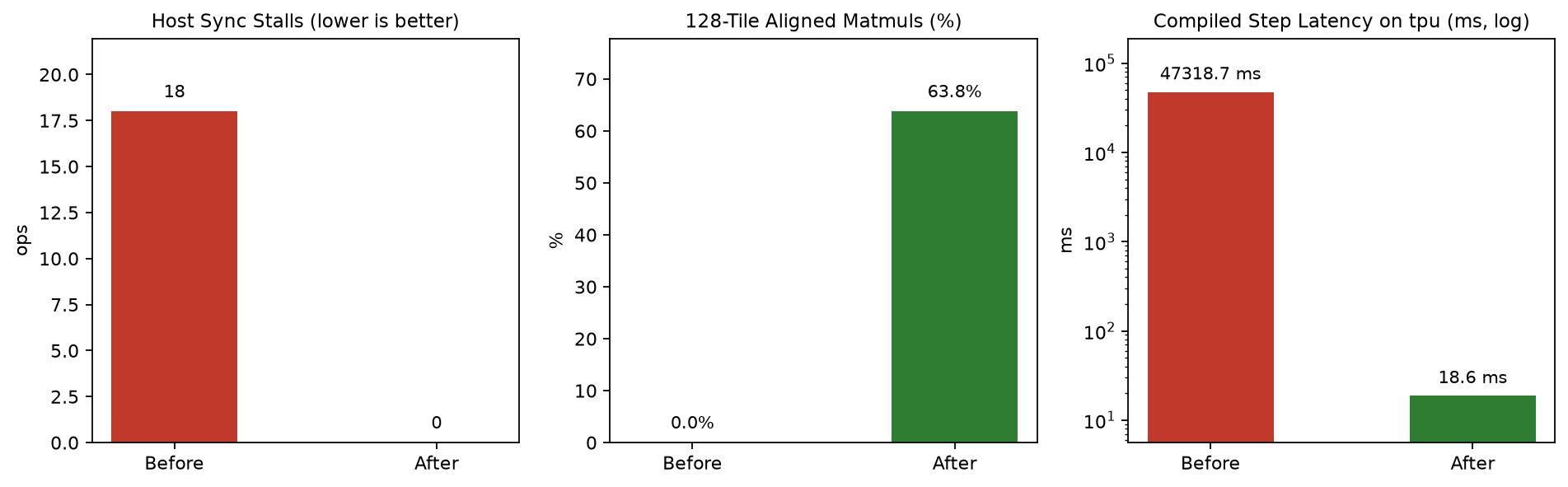
Eliminating those 12 hidden transformers syncs immediately cut bucketed eager step latency in half (456.5 ms/step down to 221.5 ms/step — 2.06× faster) and dropped host syncs from 18 to 0. I submitted this exact fix upstream in huggingface/transformers#50267 and filed the full v6e-1 ecosystem benchmark report in google-pytorch/torch_tpu#6127.
3.3 Dynamic Batch Padding (padding=True), 8×128 MXU Tiles & Dummy-Row NaNs (TPU003)
Qwen2.5-0.5B-Instruct already has TPU-friendly projection dimensions (hidden_size=896, intermediate_size=4864, vocab_size=151936—all exact multiples of 128). Yet tokenizer(texts, padding=True) pads each mini-batch only to that batch’s longest sequence, yielding 6 distinct (batch, seq) shapes in 6 steps:
Under torch.compile(model, backend="tpu", dynamic=False), every unseen shape misses TorchTPU’s graph cache and triggers a fresh full-graph StableHLO compilation (44.4s–77.4s), while ragged dimensions under-utilize the TPU Matrix Multiply Unit’s native $(8 \times 128)$ systolic tiles:
The Fix: Bucket sequence lengths to fixed multiples of 128 and pad ragged batch sizes to multiples of 4 or 8 with labels = -100. One subtle numerical trap I hit on v6e-1: if a dummy padded batch row has an all-zero attention_mask, SDPA softmax backward computes $0 \times \text{NaN} = \text{NaN}$ gradients! Keeping token 0 unmasked (attention_mask[:, 0] = 1) on dummy rows while keeping all labels = -100 keeps attention backward finite without contributing to loss or parameter updates:
collator = ttd.TileAlignedCollator(
    pad_to_multiple_of=128,
    buckets=(128, 256, 512, 1024),
    pad_token_id=tokenizer.pad_token_id,
    pad_batch_to_multiple_of=4,
)
# Those 6 ragged batches now map cleanly to 2 static shapes: [(4, 128), ..., (4, 256)]
3.4 Partial-Slice In-Place Writes & XLA Buffer Donation (TPU004)
Under the hood, XLA StableHLO operates on immutable functional tensors and relies on buffer donation to make PyTorch mutations zero-copy in HBM. Writing into a partial slice view whose backing UntypedStorage is larger than the slice lowers to a dynamic-update-slice scatter that can copy the entire backing buffer whenever XLA cannot prove alias uniqueness:
# Avoid inside compiled steps / hot loops: mutates a slice view of a larger storage buffer
loss_history[step : step + 1] = loss.detach()

# Prefer: out-of-place tensor ops (`torch.where` / `torch.cat`) or scalar device accumulation
loss_sum = loss_sum + loss.detach().float()
3.5 float64 Casts, Precision.HIGHEST, and Non-Unit Minor Strides (TPU005 & TPU006)
TPU Matrix Multiply Units (MXUs) natively run bfloat16 multiplication with float32 accumulation (Precision.DEFAULT), while the Vector Processing Unit (VPU) handles IEEE-754 float32. Casting tensors to float64 (.double()) bypasses fast native MXU paths. When a numerically sensitive layer genuinely requires higher float32 matmul precision, scope torch.tpu.precision locally instead:
# Avoid: float64 falls off the fast MXU path
# logits = logits.double()

# Prefer: float32 / bfloat16, scoping Precision.HIGHEST only where numerically required
logits = logits.float()
if device.type == "tpu":
    with torch.tpu.precision(torch.tpu.Precision.HIGHEST):
        ...
Similarly, operating on non-contiguous 3D+ views whose innermost dimension is not unit-strided (stride[-1] != 1) can force physical HBM relayout copies across (8, 128) tiles.
4. Inside the torchtpu-doctor Architecture
Rather than leaving these lessons as a static checklist, I packaged them into a lightweight ~885-line Python toolkit (src/torchtpu_doctor/) spanning four layers of the developer workflow:
┌────────────────────────┐    ┌────────────────────────┐    ┌────────────────────────┐
│   1. AGENT SKILL       │    │   2. STATIC SCANNER    │    │   3. LIVE GUARD        │
│   SKILL.md             ├───►│   torchtpu-doctor scan ├───►│   with tpu_doctor():   │
│   (Antigravity/Claude) │    │   (Zero-dep AST rules) │    │   (TorchDispatchMode)  │
└────────────────────────┘    └────────────────────────┘    └───────────┬────────────┘
                                                                        │
                                                                        ▼
                                                            ┌────────────────────────┐
                                                            │   4. RUNTIME PATCHES   │
                                                            │   patch_hf_tpu() +     │
                                                            │   TileAlignedCollator  │
                                                            └────────────────────────┘
4.1 Zero-Dependency Static AST Scanner (torchtpu-doctor scan)
scan.py walks Python ASTs using only the Python standard library—so you can lint training scripts locally or in CI (--strict, --json, # noqa: TPU002) in milliseconds without installing PyTorch or spinning up a TPU VM:
| Rule | Detects | Recommended Fix |
|---|---|---|
TPU001 |
.cuda(), 'cuda'/'nccl' literals, internal torch.tpu.is_available(), unpatched peft / sentence-transformers helpers |
Use get_device() / torch.accelerator.* and call patch_hf_tpu() |
TPU002 |
.item(), .cpu(), .numpy(), .tolist(), or synchronize() inside loops / forward() |
Accumulate detached scalars on device; read .item() on log intervals |
TPU003 |
padding=True without pad_to_multiple_of=128; hot-path nonzero() / unique() / masked_select() |
Use TileAlignedCollator (pad_to_multiple_of=128) and fixed-shape torch.where |
TPU004 |
In-place slice assignment (buf[i:i+1] = x) inside loops / forward() |
Prefer out-of-place ops under torch.compile(backend="tpu") to preserve buffer donation |
TPU005 |
torch.float64 / .double() casts and manual .as_strided() views |
Use bfloat16 or float32 (torch.tpu.Precision.HIGHEST if needed) and unit minor strides |
TPU006 |
Legacy torch_xla imports (xm.xla_device(), xm.mark_step()) |
Migrate to native device="tpu" and torch.compile(model, backend="tpu", dynamic=False) |
Running torchtpu-doctor scan against our baseline script flags all four static issues immediately:
$ torchtpu-doctor scan examples/naive_lora_sft.py
naive_lora_sft.py:12: TPU001 `peft.utils.other.infer_device()` omits 'tpu' and falls back to 'cpu' -> call `patch_hf_tpu()` at startup or use `get_device()`
naive_lora_sft.py:43: TPU003 `padding=True` without `pad_to_multiple_of=128` causes per-batch XLA recompiles -> pass `pad_to_multiple_of=128` or use `TileAlignedCollator`
naive_lora_sft.py:77: TPU004 in-place slice write inside loop/forward can break XLA buffer donation -> prefer out-of-place `torch.where` / `torch.cat` under `torch.compile(backend='tpu')`
naive_lora_sft.py:78: TPU002 `.item()` in hot path flushes TorchTPU deferred fusion queue -> accumulate tensors on device and read `.item()` only on log steps

Found 4 potential TorchTPU issue(s).
4.2 Live TorchDispatchMode Warmup Profiler (with ttd.tpu_doctor():)
Static linting catches anti-patterns in your own files, whereas guard.py subclasses PyTorch’s TorchDispatchMode to inspect every ATen op dispatched across 2 to 6 warmup steps—including ops triggered deep inside third-party packages:
from torch.utils._python_dispatch import TorchDispatchMode

class _Mode(TorchDispatchMode):
    def __torch_dispatch__(self, func, types, args=(), kwargs=None):
        parent._record(torch, func, args, kwargs or {})
        return func(*args, **kwargs)
Across doc.step() boundaries, _record audits aten::_local_scalar_dense / .to("cpu") host syncs, partial-slice storage writes, broken minor strides, FLOP-weighted 8×128 MXU tile fill, and step-level shape profiles (comparing each step’s frozenset of (op, input_shapes) so Transformers with heterogeneous q_proj, k_proj, gate_proj, and lora_A/B shapes report 0 dynamic ops once bucketed).
Here is the real v6e-1 dispatch audit before and after applying torchtpu-doctor:
torchtpu-doctor [before:naive_lora] (6 steps, 27714 ops, 70668.4 ms)
  host syncs (.item/.cpu) : 18
  dynamic shape ops       : 2
  partial-slice writes    : 6
  strided 3D+ view ops    : 0
  128-aligned matmuls     : 0/1590 (98.8% MXU lane fill)

torchtpu-doctor [after:tpu_aligned_lora] (6 steps, 27648 ops, 1329.3 ms)
  host syncs (.item/.cpu) : 0
  dynamic shape ops       : 0
  partial-slice writes    : 0
  strided 3D+ view ops    : 0
  128-aligned matmuls     : 1014/1590 (99.9% MXU lane fill)
  status: clean (ready for torch.compile(backend='tpu'))
4.3 Agent Skill (SKILL.md) for AI Coding Assistants
Because frontier coding models were trained heavily on older torch_xla repositories, prompting an agent to “port this PyTorch script to Cloud TPU” almost always produces legacy import torch_xla.core.xla_model as xm and xm.mark_step() code. Dropping .agents/skills/torchtpu-doctor/SKILL.md into .agents/skills/ (Google Antigravity) or .claude/skills/ (Claude Code) equips the agent with native torch_tpu idioms (torch.accelerator, patch_hf_tpu(), TileAlignedCollator, backend="tpu") from the very first prompt.
5. Putting It All Together: The 18.6 ms/step TPU LoRA Loop
Combining persistent Tier-3 compilation caching, patch_hf_tpu(), TileAlignedCollator, warmup auditing, and static torch.compile(backend="tpu") (examples/tpu_lora_sft.py):
import torch
from peft import LoraConfig, get_peft_model
from transformers import AutoModelForCausalLM, AutoTokenizer
import torchtpu_doctor as ttd

# 1. Configure persistent Tier-3 disk cache before TPU init & patch HF helpers
ttd.enable_tpu_cache("/tmp/torchtpu_cache")
ttd.patch_hf_tpu()
device = ttd.get_device()

tokenizer = AutoTokenizer.from_pretrained("Qwen/Qwen2.5-0.5B-Instruct")
base = AutoModelForCausalLM.from_pretrained("Qwen/Qwen2.5-0.5B-Instruct", dtype=torch.bfloat16)
base.config.use_cache = False
model = get_peft_model(
    base, LoraConfig(r=8, lora_alpha=16, target_modules=["q_proj", "v_proj"], task_type="CAUSAL_LM")
).to(device)

# 2. Bucket sequence lengths to 128-multiples and batch size to 4-multiples
collator = ttd.TileAlignedCollator(
    pad_to_multiple_of=128,
    buckets=(128, 256),
    pad_token_id=tokenizer.pad_token_id,
    pad_batch_to_multiple_of=4,
)
optimizer = torch.optim.AdamW(model.parameters(), lr=2e-4)

# 3. Audit warmup steps under TorchDispatchMode before compiling
with ttd.tpu_doctor("lora_audit") as doc:
    for batch in warmup_batches:
        optimizer.zero_grad(set_to_none=True)
        loss = model(**batch).loss
        loss.backward()
        optimizer.step()
        doc.step()
print(doc.result.format_text())

# 4. Compile outside TorchDispatchMode, warm static buckets once, and defer .item()
compiled_model = torch.compile(model, backend="tpu", dynamic=False)
loss_sum = torch.zeros((), device=device, dtype=torch.float32)

for batch in aligned_batches:
    optimizer.zero_grad(set_to_none=True)
    loss = compiled_model(**batch).loss
    loss.backward()
    optimizer.step()
    loss_sum = loss_sum + loss.detach().float()

torch.accelerator.synchronize()
print(f"mean_loss={(loss_sum / len(aligned_batches)).item():.4f}")
6. End-to-End Benchmarks on Cloud TPU v6e-1
Full executed cell outputs are preserved in notebooks/torchtpu_doctor_demo.ipynb:
| Metric | Before (Naive GPU Port) | After (torchtpu-doctor) |
|---|---|---|
peft.utils.other.infer_device() |
'cpu' |
'tpu' |
Unique (batch, seq) shapes (6 steps) |
6 ((3, 27) .. (3, 141)) |
2 ((4, 128), (4, 256)) |
Host sync stalls (aten::_local_scalar_dense) |
18 (3 / step) |
0 |
| Dynamic-shape ATen ops | 2 |
0 |
| Partial-slice storage writes | 6 |
0 |
| 128-tile aligned matmuls | 0 / 1590 (0%) |
1014 / 1590 (64%) |
| FLOP-weighted MXU lane fill | 98.8% |
99.9% |
| Eager 6-step audit wall time | 70,668 ms |
1,329 ms (53.2× faster) |
torch.compile(backend="tpu") step time |
47,318.7 ms/step |
18.6 ms/step (2,537× faster) |
(Why 1014 / 1590 aligned matmuls instead of 1590 / 1590? Every base Qwen2.5-0.5B projection and lm_head matmul is 100% 128-tile aligned once batch * seq is 512 or 1024; the remaining 576 matmuls across 6 steps are the intentionally low-rank r=8 LoRA adapter projections, which account for ~0.1% of total FLOPs.)
Breaking the timings down rung by rung shows exactly where every speedup comes from:
Configuration on Cloud TPU v6e-1 |
Mean Latency | What Happens Under the Hood |
|---|---|---|
1. Naive eager (padding=True, loss.item()) |
11,778.1 ms/step |
Every new (3, seq) shape triggers fresh op compilations + 3 host syncs/step. |
2. Bucketed eager (TileAlignedCollator, deferred loss) |
456.5 ms/step |
Static (4, 128) / (4, 256) buckets eliminate shape drift, still stalling twice/step inside transformers. |
3. Clean eager (+ patch_hf_tpu()) |
221.5 ms/step |
Short-circuiting _ignore_causal_mask_sdpa boolean readbacks cuts eager step time in half (0 host syncs). |
4. Naive torch.compile(backend="tpu", dynamic=False) |
47,318.7 ms/step |
Step 0 runs in 41.0 ms (warmed), then steps 1–5 each pay 44.4s–77.4s full-graph StableHLO recompiles. |
5. Clean torch.compile(backend="tpu", dynamic=False) |
18.6 ms/step |
Whole-step compiled graph (11.9× faster than clean eager), persisted across restarts via TORCH_TPU_TIER3_COMPILATION_CACHE_ROOT. |
7. Upstream Ecosystem Contributions (transformers, peft, torch_tpu)
Building torchtpu-doctor and running live TorchDispatchMode audits on a Cloud TPU v6e-1 VM surfaced genuine ecosystem gaps in first-party libraries—not just user-script mistakes. While torchtpu_doctor.patch_hf_tpu() patches these in memory immediately so existing pip installs run cleanly today, I also contributed the fixes and hardware reproductions directly upstream:
| Upstream Repository | Contribution | Root Cause Caught by torchtpu-doctor |
Measured Impact on Cloud TPU v6e-1 |
|---|---|---|---|
huggingface/transformers#50267 |
PR: [Masking] Avoid device-to-host sync in _ignore_causal_mask_sdpa on TPU |
_ignore_causal_mask_sdpa calls fast_all(padding_mask) twice per eager forward pass, firing 2 blocking aten::_local_scalar_dense (torch.bool) TPU-to-CPU transfers per step. Short-circuits to False when padding_mask.device.type == "tpu" (matching is_tracing). |
Cuts bucketed eager LoRA step latency 2.06× (456.5 ms/step → 221.5 ms/step; 12 → 0 host syncs). |
huggingface/peft#4099 |
PR: FIX: Support torch.accelerator backends (e.g. torch_tpu) in infer_device() |
peft.utils.other.infer_device() walks cuda, mps, mlu, xpu, npu and silently falls through to "cpu" across PeftModel, save_and_load, hotswap, and user LoRA scripts on PrivateUse1 (device="tpu"). Adds torch.accelerator.is_available() fallback + CI unit tests. |
Moves LoRA fine-tuning off silent host CPU fallback onto tpu:0 (53.2× faster eager; 2,537× compiled with static buckets). |
google-pytorch/torch_tpu#6127 |
Issue: [Ecosystem / Hugging Face] Silent host syncs in transformers.masking_utils & CPU fallback in peft on torch_tpu 0.2.0 |
Documents both Hugging Face PrivateUse1 ecosystem bottlenecks, TorchDispatchMode stack traces, and reproducible Qwen2.5-0.5B-Instruct LoRA timings on v6e-1 (torch_tpu 0.2.0, libtpu 0.0.51) for the TorchTPU maintainers and user guide. |
Coordinates upstream ecosystem fixes across torch_tpu, transformers, and peft. |
8. Practical Caveats for Production Workloads
Two engineering boundaries to keep in mind when adopting torchtpu-doctor:
- Wrap warmup steps only—not full training epochs: Because
TorchDispatchModeintercepts every ATen call in Python, wrap 2 to 6 eager warmup steps insidewith ttd.tpu_doctor():, verifystatus: clean, and exit the context manager before invokingtorch.compile(model, backend="tpu", dynamic=False). - Single-chip readiness before multi-chip scale-out:
torchtpu-doctortargets single-chip XLA compilation stability, host-device sync elimination, and MXU tile occupancy. Once single-chip execution is clean and you scale across multi-chip ICI pods withDTensororFSDP, pair it withtorch.profilerandXProfto inspect collective communication overlap.
9. Try It Out & References
Install directly from GitHub and run the static scanner or self-contained dispatch demo on any machine:
pip install git+https://github.com/jigyasa-grover/TorchTPU-Doctor.git
torchtpu-doctor scan path/to/your/repo
torchtpu-doctor demo
- GitHub Repository: github.com/jigyasa-grover/TorchTPU-Doctor
- Colab / Cloud TPU
v6e-1Notebook:notebooks/torchtpu_doctor_demo.ipynb - Before & After Sample Scripts:
examples/naive_lora_sft.pyandexamples/tpu_lora_sft.py - Upstream PRs & Ecosystem Report:
huggingface/transformers#50267— Avoid device-to-host sync in_ignore_causal_mask_sdpaon TPUhuggingface/peft#4099— Supporttorch.acceleratorbackends (e.g.torch_tpu) ininfer_device()google-pytorch/torch_tpu#6127— Silent host syncs intransformers.masking_utils& CPU fallback inpeftontorch_tpu 0.2.0
- Further Reading:
Hope you enjoyed this deep dive; check out the complete toolkit, Agent Skill, and benchmark notebook on GitHub 🩺
Huge thanks to Google, Google Cloud, and the Google ML Developer Programs & Cloud TPU teams for organizing #TorchTPUSprint and generously providing the Cloud TPU compute resources for these benchmarks.
Google Cloud credits are provided for this project✨
#BuildWithAI #BuildWithTPU #TorchTPU #TorchTPUSprint #PyTorch #GoogleCloud